

By John Helmer, Moscow
@bears_with
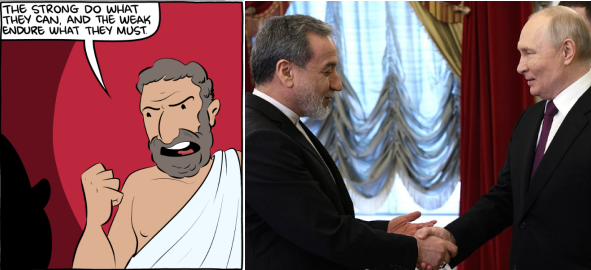
There is a 2,500-year old message about who is strong, who is weak in politics and war, and what the latter can do to defend themselves from the former.
The message comes from Thucydides in his History of the Peloponnesian War. Written between five and ten years after the events described, which occurred in 416 BC, it was part of a negotiation between the invading Athenian forces and the Melos islanders, who wanted to remain neutral in the war between Athens and Sparta. The message was part of the Athenian refusal to accept this neutrality and the Athenian ultimatum – either the Melians surrendered, or they would be killed. The Melians refused; the Athenians then killed all the men, enslaved the women and surviving children; and repopulated the island with Athenians.
This is the message: “The standard of justice depends on the equality of power to compel and the strong do what they have the power to do and the weak accept what they must.”
The second, consequential sentence is the most famous of lines still quoted from Thucydides. The weak will have to submit to the strong — that was the warning. Do what we want or we will kill you. Almost never quoted and forgotten, however, is the first, conditional sentence.
That ancient condition is still the modern calculation. If the weak can devise enough power to resist, to undermine the power to compel, to make the strong uncertain of the outcome of their threats and displays of force — if their defeat and death can be credibly threatened in retaliation, then the strong can be deterred.
In just this way, the “equality of power” can be upset. Neither justice in the outcome, nor the history of the war to achieve it, will always be dictated by the strong. Exaggerating your strength if you think you are strong, and over-estimating the weakness of your adversary can cost you defeat, maybe your life.
This is where the regime of President Donald Trump is today as he dictates terms to Iran.
President Vladimir Putin told Foreign Minister Abbas Araghchi at their meeting on Monday in St Petersburg: “We see how courageously and heroically the Iranian people are fighting for their independence and sovereignty… For our part, we will do everything that meets your interests.” This appeared to be an unqualified declaration of Russia’s support for Iran to resist Trump’s terms.
Unqualified, however, it is not. At least not on Putin’s part. His spokesman and advisor on foreign policy, Yury Ushakov, Russian ambassador to the US between 1998 and 2008, issued the qualifier: “We will analyze what he [Araghchi] will say, and analyze against the background of today’s conversation the signals that we have received from both the Americans and the Israelis. And then we’ll see what to do.” In other words, Putin will balance Iran the defender against the US and Israel the attacker. Putin will measure their respective strengths and then choose which side to take in the fight.
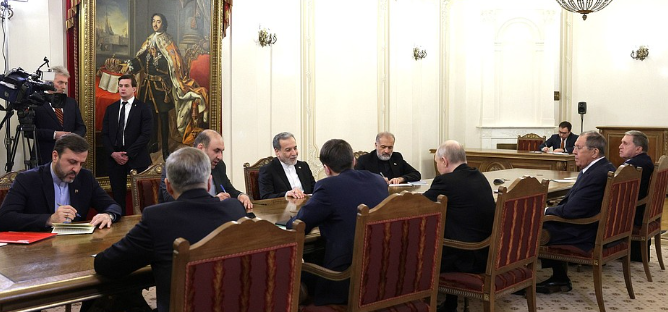
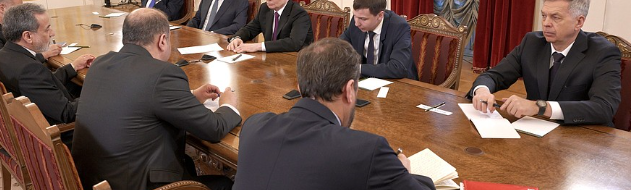
Photo key to strength: http://en.kremlin.ru/events/president/news/79633
At wall: Dmitry Peskov left, (partially obscured);  security man;  Tsar Peter the Great. Iranian side of the table: Deputy Foreign Minister for Legal and International Affairs (nuclear negotiations) Kazem Gharibabadi; interpreter;  Abbas Araghchi;  Iran’s Ambassador to Russia, Kazem Jalali. Foreground: Admiral Kostyukov;  interpreter;  President Putin reading from notes;  Foreign Minister Lavrov;  Advisor Ushakov.
Putin himself had hinted at this in the Kremlin communiqué. “For our part, we will do everything that meets your interests,” he had told Araghchi, adding:” and the interests of all peoples in the region in order to ensure that this peace is achieved as quickly as possible. You are well aware of our position.” Putin meant to include in “all peoples in the region” the Americans in their bases, the Arabs and the Israelis in the attacking alliance against Iran.
Exactly how Putin weighs strength and weakness was explained by his foreign minister, Sergei Lavrov, as he concluded a local press interview on April 24. “The President of Russia has noted repeatedly: ‘The weak are beaten.’” Lavrov believed he was quoting Putin quoting Thucydides quoting the Athenian ultimatum to the Melians. Then Lavrov added Putin’s interpretation: “The conclusion is straightforward: we must be strong. Russia has significant strengths: resilience of spirit, vast natural resources, and scientific potential. The key task is to translate these advantages…”
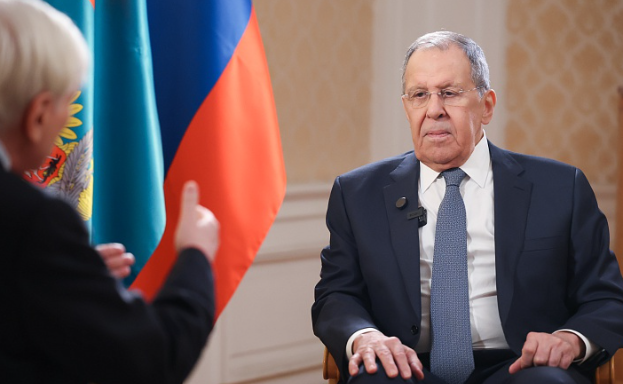
Sergei Lavrov in interview with Russian public television, April 24: https://mid.ru/en/foreign_policy/news/2099121/
This idea of being strong, as Putin expressed it, stops short of the pre-conditional “equality of power to compel”. Putin’s interpretation today is the Athenian one. When he explains it through Ushakov, he is conceding the American, Israeli, Saudi and Emirati strength. He is accepting that he must weigh their strength combined against Iran’s weakness alone, and “then we will see what to do.” Putin is putting Russia on the side of the strong, as he calculates it himself.
Unlike the Melian answer to the Athenians, Putin is inviting the Americans, Israelis and Arab sheikhs to demonstrate their dominance, escalate, compel. This is the opposite of a strategy of defence by deterrence. It’s weakness.
The Melian answer, according to Thucydides, was: “you force us to leave justice out of account and to confine ourselves to self-interest”. Beware you don’t miscalculate for the long run, they warned: “your own fall would be visited by the most terrible vengeance and would be an example to the world.”
In Thucydides’s account, there is only one Athenian voice, only one Melian voice. Also, Thucydides didn’t record the end of the story. That came a decade later when the Spartans won the war against the Athenians, and despite the genocide, restored the surviving Melian women and children to the island, and established a fully defended Spartan colonial administration.
When Araghchi met with Putin, at the table Ushakov was off to the extreme right, out of focus in most of the official Kremlin photographs. Putin’s other spokesman, Dmitry Peskov, was standing against a wall, without a seat.
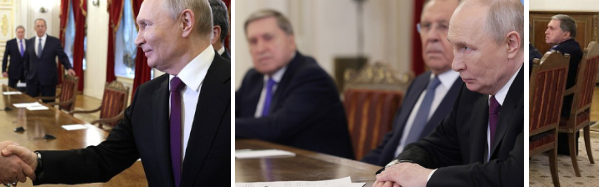
Putin spokesman and foreign affairs advisor Yury Ushakov at left, out of focus, in images left and centre; at the right end of the table in image right.
The key Russian figure was Admiral Igor Kostyukov, head of the GRU, the military intelligence agency.
His presence signals a different calculation of strength and weakness from Putin’s in the current war – and not only the war against Iran, but also the US war against Russia in the Ukraine. Kostyukov is playing a visibly more powerful role in the negotiations for that war, too. The Russian military, supported by the intelligence agencies and Foreign Ministry and backed by the consensus of the Security Council, are pursuing a strategic line which Putin avoids endorsing in public but cannot block.
Left, Foreign Minister Araghchi; right, Admiral Kostyukov.
View or listen now to the hour-long podcast discussion with Nima Alkhorshid, aired on April 28, of Russia’s two-track, two-strength policy toward defending Iran and ingratiating the Trump Administration.
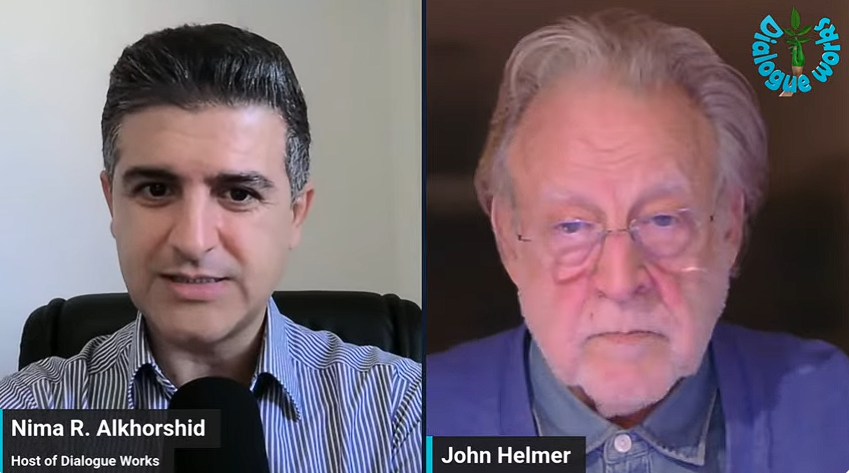
“The [Araghchi] visit couldn’t be more important as the world tries to cope with this war. It’s now a global war in the economic sense... something very important happened but for the time being the state media have almost blacked out what happened... There’s been no commentary, no analysis.” https://www.youtube.com/watch?v=HfIxqx3QAVE
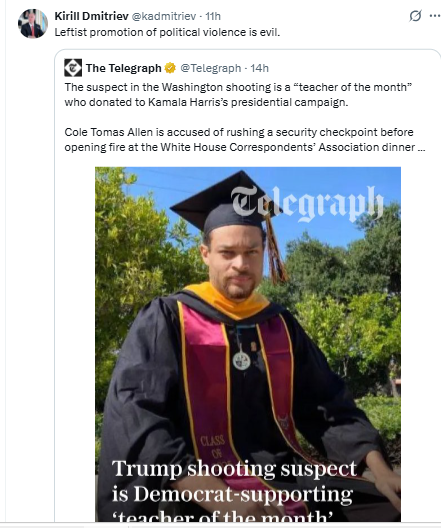
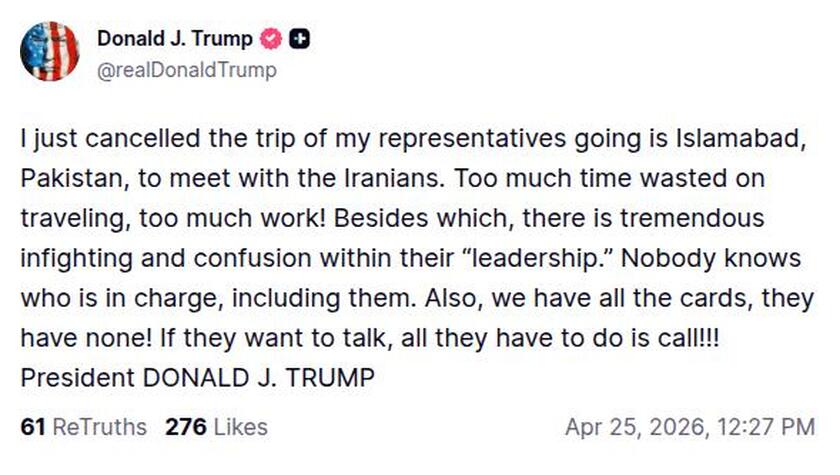
In reporting the record which the pro-American faction around Putin are making, part of the evidence is in the stream of daily tweets by Kirill Dmitriev, the President’s negotiator with the Trump family. Dmitriev has ignored the US war against Iran,. And instead he has promoted every form of endorsement of Trump, including this claim Dmitriev published after the attempted assassination in Washington on April 25 that criticism of Trump is “leftist”:



Leave a Reply