

By John Helmer, Moscow
@bears_with
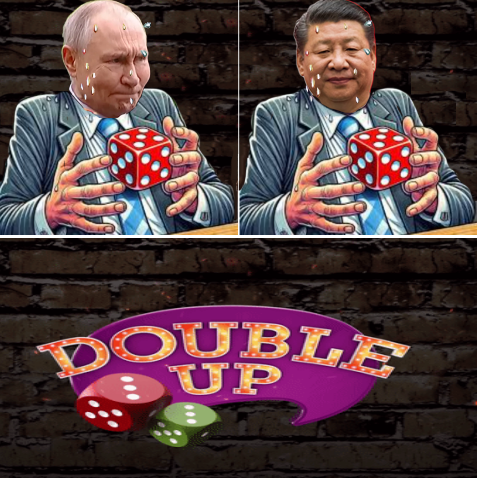
Doubling down is what the alliance of Russia’s enemies should do now, editorializes the Financial Times, the Japanese propaganda platform in London, pointing at the summit meeting in Beijing between President Vladimir Putin and President Xi Jinping. The alliance “should take confidence in their strategy — even if it will be a long haul — and double down on supporting Ukraine with the weapons, intelligence and cash needed to see it through.”
One Anglo-Japanese stone, two Sino-Russian birds – “even if Moscow is ever more the junior partner in the relationship, this will be an opportunity for the Russian president to project strength beside a fellow strongman leader”.
The two birds reply with stones of their own.
In a survey of 53 China-based Chinese political analysts, comparing what they were saying before the Xi-Trump summit and then afterwards, Jacob Mardell, a British researcher based in Berlin, reports the Chinese consensus is that “the balance of power has shifted, forcing Washington into a more equal relationship with Beijing…[that] Trump’s ‘new realism’ [is] recognition that ‘China has already risen’ and that the US ‘cannot defeat China’…[and that] stability now rests less on trust than on parity, resilience and mutual constraint. Taiwan is framed as the principal test of whether the new framework can endure. Most authors read Trump’s comments opposing ‘Taiwan independence’ as a meaningful concession.”
TRUMP ON TAIWAN AS A “NEGOTIATING CHIP FOR US”
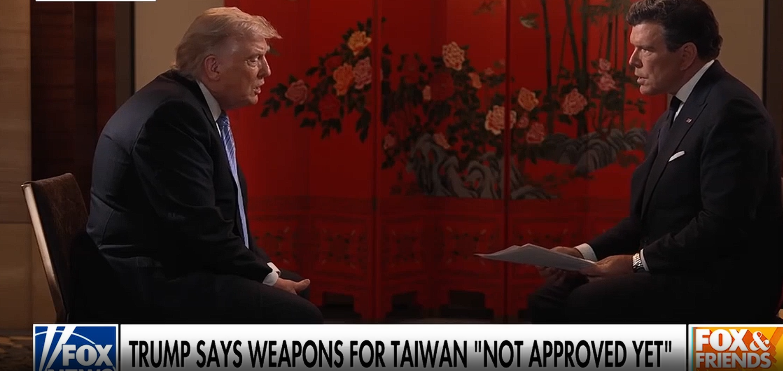
“Last night, we talked the whole night about that issue. I think I'm, I know more about Taiwan right now than I know about almost any country other than -- …But they have somebody there now that wants to go independent. Well, it's a very risky thing. When you go independent, you know, they are going independent because they want to get into a war, and they want to, they figure they have a United States behind them, I'd like to see it stay the way it is…nothing has changed. I will say this: I'm not looking to have somebody go independent, and you know, we are supposed to travel 9,500 miles to fight a war. I'm not looking for that. I want them to cool down. I want China to cool down… have not approved it [second tranche of Taiwan arms] yet. We are going to see what happens…What do you looking for? I may do it. I may not do it. But I may do it, I may not do it. But we are not looking to have wars, and we are, if you kept it the way it is, I think China is going to be OK with that. But we are not looking to have somebody say let's go independent, because the United States is backing us. You know?.. he [Xi] thinks I could do it with just the signing of my signature, unlike Biden, who couldn't sign his signature. No, I'm holding that in abeyance, and it depends on China. Depends, it's a, it's a very good negotiating chip for us, frankly. It's a lot of weapons, it's $12 billion.” Source: https://www.foxnews.com/media/trump-warns-taiwan-expect-blank-check-us-military-intense-xi-summit Wang Yi replied: “impression coming out of the summit" is that the U.S. side "understands China's position, takes China's concerns seriously," and "like the rest of the international community, does not agree with or accept Taiwan moving toward independence."
The survey also reveals what isn’t there – no mention of either Russia or Iran, or of the claims President Trump and White House officials have made after returning to Washington that Xi “agreed Iran cannot have a nuclear weapon, called to reopen the Strait of Hormuz, and agreed that no country or organization can be allowed to charge tolls [and] confirmed their shared goal to denuclearize North Korea.”
Mardell’s survey of the China commentariat also reveals no confirmation that Xi told Trump China would supply no weapons to Iran; no confirmation that Xi told Trump that Putin “might end up regretting his invasion of Ukraine.”
The consensus of the Chinese analysts also ignores the refusal of Xi and his foreign policy guide Wang Yi, to convey any form of warning, caution, or deterrence for Trump to resume his attack on Iran in the coming days, as Iranian officials are expecting.
For a detailed discussion of how the Xi-Trump summit will now impact on the two wars and on the Putin summit meetings in Beijing, starting today (May 20), click to view or listen.

Source: https://www.youtube.com/watch?v=5goLZOjDniE
In a parallel survey of Chinese analysts writing on China’s ambition to be recognized as the global co-hegemon with the US, nicknamed the G2, Mardell concludes that although the official Beijing line is to reject this, the real policy is “not to embrace G2 outright, but to recode it…reframe it as ‘coordination’ rather than ‘co-governance’… Beijing wants the benefits of peer recognition, practical coordination and strategic stability without the costs of an explicit two-power directorate: alienating the Global South, appearing to abandon multipolarity or accepting responsibility for a US-shaped order.”
Mardell works for a German think tank, Network for Border Crossing Journalism (N-Ost), which is financed by the German Foreign Office, the German ministries of Interior and Economic Cooperation, the European Commission, as well as through the JX Fund, Allianz Kulturstiftung, and the Foundation for German-Polish Cooperation. In 2023 N-Ost ran a series of propaganda exhibitions in support of the Ukraine; in 2025 the organization was proscribed in Moscow as an anti-Russian operation.
An earlier report from N-Ost from a writer at a British military think tank concluded that China’s policy in backing Putin’s Special Military Operation will be temporary, limited, and subordinated to the higher priority of the United States. “A large segment of Chinese public and scholarly opinion was critical of their government’s tacit support of Russia during its invasion of Ukraine, arguing that their country should ‘stand on the side of justice’…US politicians and intellectuals have for some time expressed the will to align with Russia against China; China’s early decision not to condemn Russia has significantly shrunk the possibility of this strategy attaining success. As a rule, allying with a greater power (the US) against a weaker power (Russia) is strategically unwise, given the risk of the greater power turning on you once the weaker power has been eliminated.”
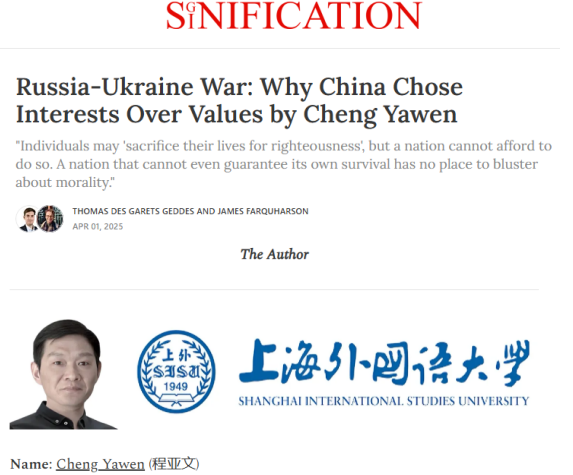
Source: https://www.sinification.org/p/russia-ukraine-war-why-china-chose?utm_source=publication-search Cheng Yawen has been associated as student and researcher with the People’s Liberation Army (PLA)
Are the Chinese analysts as hostile to Russia as the N-Ost group?
If so, the proposed “Declaration on the Emergence of a Multipolar World and a New Type of International Relations”, which Xi will shortly sign with Putin in Beijing, will be a pretence – concealing the practical acquiescence by Xi in Trump’s schemes, not only for the Ukraine war and the Iran war, but also for the pressing fate of Cuba.
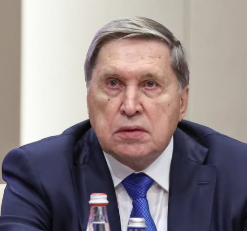
In an unusual advance readout of the summit meetings, the Kremlin foreign policy advisor and spokesman, Yury Ushakov (left) said that “Putin and Xi will discuss the most sensitive aspects of bilateral relations during Russia-China negotiations that will involve a meeting between the two leaders and talks with a large group of representatives. The leaders will discuss the issue of hydrocarbon cooperation: “I won’t go into details now, but I believe this topic will be discussed in great detail between the leaders with the participation of direct representatives who are involved in all of these projects.” They will discuss in detail the Power of Siberia-2 gas pipeline: ‘’”This topic will be discussed in great detail, it is on the agenda.’”
Putin’s visit to China, Ushakov added, “will conclude with an informal tea talk with Xi to discuss major issues. We are preparing for it [the tea party] because it is necessary to discuss everything confidentially, behind closed doors, in a friendly and sincere manner. All the issues will be discussed during that meeting over tea after official dinner.”
Ahead of Putin’s departure for Beijing, the state media platform RT confirmed there is deep Russian suspicion of Xi’s intentions for the bilateral relationship and for his G2 ambition. “Moscow has largely accepted the logic of deep strategic interdependence. Beijing, by contrast, still behaves as though it can preserve a carefully managed partnership in which China remains the senior partner while minimizing its own obligations. That model is reaching its limits. For years, the dominant narrative in Western policy circles has been that Russia has become the junior partner in an unequal relationship. Brussels think tanks, Washington analysts and even many Chinese commentators have repeated the same formula: Russia supplies raw materials and China supplies everything else… China still often behaves as though it can enjoy the benefits of strategic partnership without fully committing itself to the burdens that come with it. Moscow has already integrated Beijing deeply into critical sectors ranging from energy to logistics and food security. But many major Chinese investments and technology commitments continue to move cautiously or remain delayed. At some point, Beijing will have to decide whether it truly views Russia as an equal strategic partner or merely as a useful resource base operating on China’s periphery.”
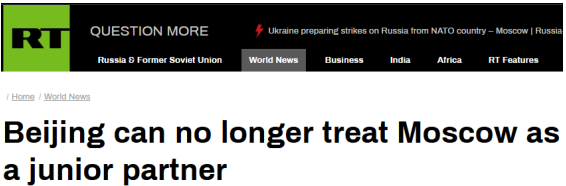
Source: https://www.rt.com/news/640052-beijing-moscow-sanctions-partnership/ An echo from the Russian Foreign Ministry has commented: “it’s possible that the Presidential Administration first had to approve this piece and might have even commissioned it… Speculation aside, there’s no denying that Russia’s global media flagship just published unprecedented criticism of China that shattered the Alt-Media Community’s long-running portrayal of their country’s relations with China, which sets them up for one of two game-changing scenarios…either see China de facto allying with Russia or forever abandoning this option.” On the Russian side, there is a long history of Russian supremacism towards China -- click to read more.
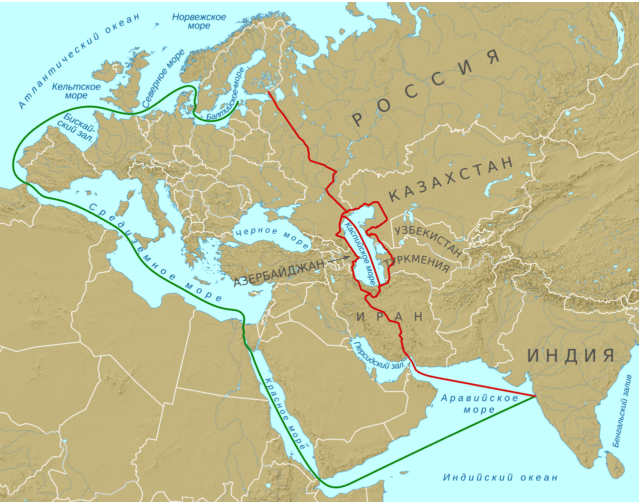
In the last part of the podcast, we reported new evidence of the acceleration of Russian deliveries by ship across the Caspian Sea to Iran. In a new report by the Moscow maritime industry source, InfraNews.ru, war impacts are revealed to be reducing Russian cargo movements across the Baltic and increasing shipments through ports on the Black, Azov and Caspian Seas.
Source: https://www.specialeurasia.com/2023/03/17/geopolitics-instc-sharov/

The cargo turnover of Russian ports in April 2026 amounted to 78.5 million tonnes, which is 8.2% more than a year earlier (+6 million tonnes). Turnover is in the black for the second month in a row after a drawdown in January-February by 5% year-on-year. In particular, transshipment of dry cargo in April increased by 13% year-on-year (+4.7 million tonnes) to 40 million tonnes, bulk cargo – by 4% (+1.3 million tonnes) to 38.5 million tonnes. Coal and oil transshipment in April increased by 8% and 9%, respectively, to 18 million tonnes and 24.6 million tonnes (+1.4 million tonnes and +2 million tonnes). Transshipment of grain (+2.9 million tonnes), LNG (+0.9 million tonnes) and cargo in containers (+0.6 million tonnes) also increased significantly relative to the level a year earlier.
In terms of marine basins, transshipment volumes in the ports of the Azov-Black Sea basin increased most strongly in April compared to last year: +3 million tonnes (+15% YoY) to 23.8 million tonnes. In the ports of the Far Eastern basin, cargo transshipment increased by 8% year-on-year (+1.7 million tons) to more than 23 million tonnes in April. The turnover of ports in the Arctic basin increased by 16% year-on-year (+1.2 million tonnes) and amounted to 8.4 million tonnes in April. At the same time, transshipment in the ports of the Baltic Basin continues to remain below last year’s level, with a total of 21.7 million tonnes handled by the end of the month (-4% or -0.9 million tonnes).
Transshipment volumes in the ports of the Caspian basin increased sharply in April to over 1.5 million tonnes, which is three times higher than the low level of the previous year. Transshipment of other general cargo (excluding metals, packaged goods, and refrigerated cargoes) increased most strongly relative to the level a year earlier to more than 530,000 tonnes at the end of the month against less than 100,000 tonnes a year earlier. Grain transshipment increased to 350,000 tonnes.
The total cargo turnover of Russian ports in January-April 2026 amounted to 289 million tonnes, which is 2.6% or 7.3 million tonnes more than a year earlier, according to Morcenter JSC. In particular, transshipment of dry cargo increased by 6% year–on-year (+8.1 million tonnes) to 142.5 million tonnes, bulk cargo decreased by 0.6% (-0.9 million tonnes) to 147 million tonnes.
Coal transshipment in 4 months amounted to 63.7 million tonnes, which is more than a year earlier by 4% or 2.7 million tonnes. Grain transshipment volumes increased by 54% year-on-year (+6.6 million tonnes) to 19 million tonnes. Transshipment of liquefied natural gas is growing in the bulk cargo category: +16% year-on-year (+2 million tonnes) to 15 million tonnes and oil: +1.9 million tonnes to 89.5 million tonnes.
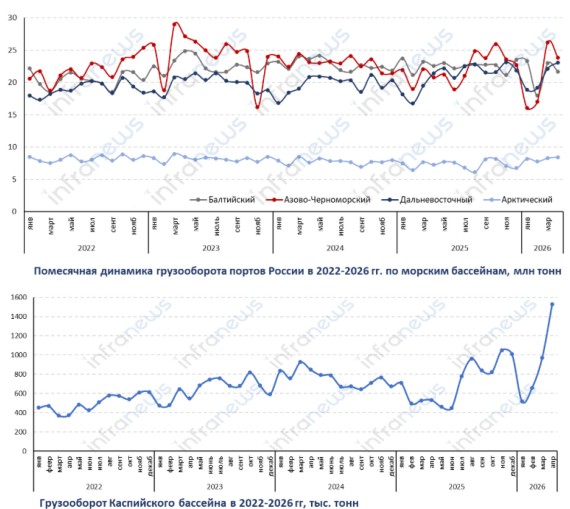
The turnover of the ports of the Baltic basin in January-April decreased by 5.2% (-4.8 million tonnes) to 86 million tonnes, the Azov-Black Sea – by 0.7% (-0.6 million tonnes) to 83 million tonnes. At the same time, the ports of the Far Eastern basin increased transshipment by 9.8% (+7.4 million tons) to 83.3 million tonnes, and the Arctic – by 13% (+3.8 million tonnes) to 32.6 million tonnes. The ports of the Caspian basin handled 3.7 million tones (+61% YoY).









Leave a Reply