

By John Helmer, Moscow
@bears_with
This is not a question. Asking it is the answer.This is because the Security Council, the politburo of Russian war and security policymaking which President Vladimir Putin leads but does not fully control, rarely issues public statements; it never issues one like the announcement of April 14.
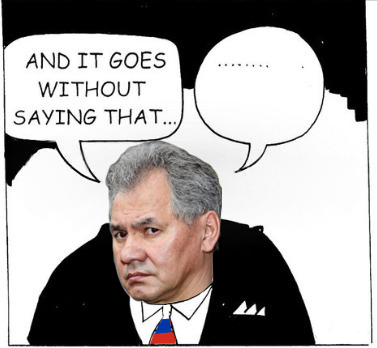
Putin is the ex officio head of the Council. Sergei Shoigu (lead image) is Putin’s executive stand-in, titled Secretary. Defense Minister between 2012 and 2024, Shoigu’s removal has triggered the replacement and prosecution of his deputies at the Ministry of Defense for corruption. The purge of the Shoigusites was delayed by nine months following the death by contrived misfortune of Yevgeny Prigozhin, boss of a rival military procurement racket.
The Council has 13 permanent members; another 18 members representing the regional political constituencies of the country, the presidential guard (Rosgvardiya, Росгвардия) commander, and the chiefs of the Council’s principal staffs called deputy secretaries. The staff, called the Secretariat, is divided into seven subject or area competencies, and numbers about 200 officials, possibly many more on temporary secondment.
The website of the organization, scrf.ru, is unshy but reticent; for the most part it repeats the Kremlin posting of the regular weekly or fortnightly sessions of the Council with the President. According to the website, only one meeting of the Council has been held so far to discuss the US-Israeli war against Iran. That was reported on February 28. The Council’s public statement was: “The President held an operational meeting with the permanent members of the Security Council via video link. The situation around Iran was discussed.”
The Kremlin communiqué of the meeting revealed the time of the post was 1630. This meant the session had been called at least four hours after the first attacks on Teheran had begun, killing the Supreme Leader Ali Khamenei and several military commanders and policymakers. Since then the official log records seven discussions of the “Iran situation”
The most recent was dated April 14.
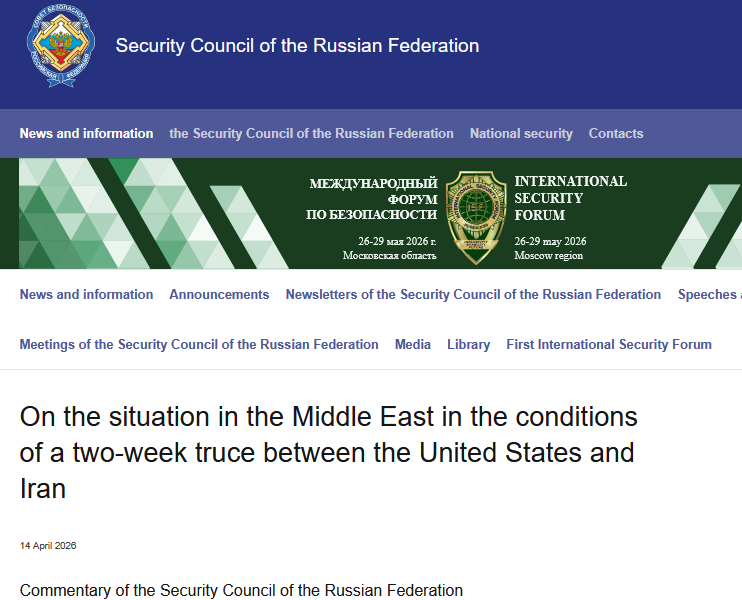
Source: http://www.scrf.gov.ru/news/allnews/4038/
This noted there were “diametrically opposed interpretations” from the US and Iran of the ceasefire – the Russian term used was перемирии, “truce” – each claiming victory over the other. With endorsement, the Council reported “international experts [saying that] this truce will not last long. The reason lies that neither the United States nor Israel has achieved their goals in the course of the military actions.” The Islamabad negotiations were summarized as producing no agreement. The Iranian and American versions of the blockade of the Strait of Hormuz were also reported; then a summary of US Central Command force deployments to the region.
The conclusion of the statement was: “The United States and Israel can use peace negotiations to prepare for the ground operations against Iran, as the Pentagon continues to build up the grouping of forces of the United States in the region…We should also expect active actions of the coalition forces to replenish the strike and anti-missile weapons, as well as significant activity of reconnaissance forces. In the case of failure to achieve the goals of the negotiations after two weeks, the fighting can resume with greater intensity.”
As the Council drafters pointed out, the source of everything reported on April 14 was either “international experts”, or President Donald Trump’s tweets and press comments, or US Central Command press releases. No Russian intelligence source was identified. Nothing non-obvious was reported. As titled, this was not a Council commentary at all.
The statement was picked up in the evening of April 14 by the state news agency, Tass. It headlined the release a warning.
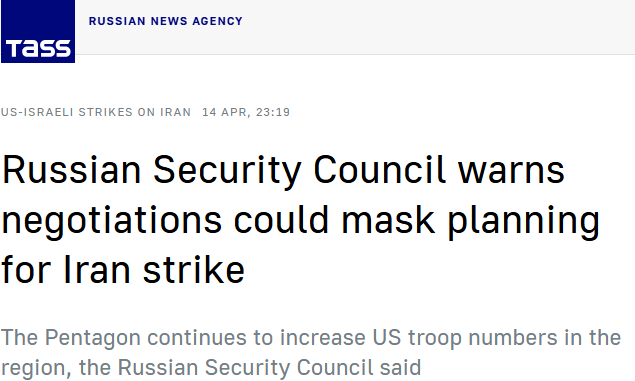
Source: https://tass.com/politics/2117055
“The United States and Israel could be using peace talks to cover preparations for a ground operation in Iran, the Russian Security Council said in a statement,” Tass reported – without providing a link to the original release. “We should also expect active actions by the coalition forces to replenish strike and anti-missile weapons, as well as significant activity by reconnaissance forces.”
Between the 893-word Security Council “commentary” and the 269-word Tass report, there was no difference except for the Tass interpretation that the Security Council was intending a warning that the US and Israel were not negotiating in good faith and were using the direct and indirect talks with Iran as a smokescreen for a new attack.
Since Trump himself had been tweeting threats of the resumption of military operations if Iran refuses to accept his terms, what exactly was the Security Council warning, to whom, and for what purpose?
According to the official record and Kremlin disclosures, the Security Council met on April 3 to for “discussion focused on measures to counter the financing of terrorism and other criminal activities.” There was no meeting again until April 17. Putin was recorded as opening the session with the issue “we address on a regular basis: interaction with our closest neighbours, the CIS countries. We have always had, and I believe will continue to have, a special approach to this cooperation, both for historical reasons and due to the extensive work we carry out together with these countries, including economic cooperation.”
If these public disclosures reflect all that was discussed on April 3 and then on April 17, the Iran war was not a point of discussion. But even if it was, the public record reveals that the Security Council aimed to keep it secret. Neither the Council nor the President intended any public warning.
Ex-president Dmitry Medvedev, the Council’s deputy chairman, is more talkative than the Council. He may be interpreted to reflect the consensus of the military, intelligence and foreign ministry agencies. Medvedev doesn’t report “international experts” to be the source of his conclusions. “The very fact of Trump’s consent to discuss a 10-point plan,” Medvedev wrote on Telegram on April 8, “is the success of the Iranians. The question is whether Washington will agree to it: after all, will there be compensation for damage to Iran, continuation of the nuclear program, and Teheran’s control over the Strait of Hormuz. Obviously not. This is humiliating for Trump and will mean a real victory for Iran. Then what? Fighting again?”
“Perhaps, but there is an intermediate option. Trump does not want and cannot wage war for long, and the Congress will not support him. So, you need to maintain a fragile truce and pretend that everything is fine. Because every step on this board creates a position close to zugzwang. But this is a chess game in which there are not two, but three players. There is still Israel; it is not on the side of the United States. It doesn’t need a truce, and it hasn’t solved its own problems. And it may well make its own move – that’s to sweep all the pieces off the chessboard. This makes the situation extremely uncertain.”
Medvedev was issuing a clear warning against Israel – of what it may be preparing against Iran, and also against the Trump Administration in Washington. He has been silent ever since, except to announce his Easter celebration on April 12 to a reported one million views:
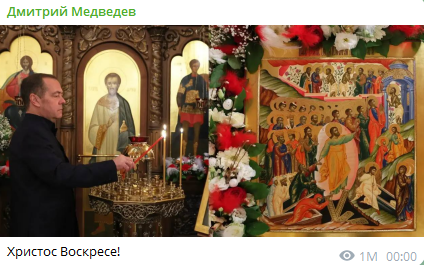
Source: https://t.me/medvedev_telegram/642#
If the text of the Security Council statement of April 14 was not the outcome of any meeting of the Council’s principals; if it was entirely open-sourced and western, not Russian; and if it made substantively less commentary than Medvedev had telegrammed several days before, who was the target of the Council’s “warning”, as Tass had characterized it? Why would the leading security policy-making organ of the Russian government go to the trouble of breaking its customary silence in order to state the obvious?
The sources in a position to know to whom these questions were referred respond with speculation, not with conviction. They believe the Security Council was issuing a warning, but not in the direction of either the Iranians or the Trump Administration, or the Israelis. They suspect the target of an official warning that American negotiations are smokescreen for sneak attack and resumption of war is the Kremlin’s negotiator with Trump officials, Kirill Dmitriev.
For the back file and background on Dmitriev, read this.
The sources point out this timing: Dmitriev was in the US on April 9 with Putin’s instruction to negotiate an extension of the waiver of the Russian oil sanction expiring on April 11. This sanction waiver had been agreed after talks in Miami in early March between Dmitriev, Steven Witkoff, Jared Kushner and US Treasury Secretary Scott Bessent. For more details, click. On April 15 it was publicly evident that Dmitriev had failed. Bessent announced on that day: “We will not be renewing the general licence on Russian oil, and we will not be renewing the general licence on Iranian oil. That was oil that was on the water prior to March 11. So all that has been used.”
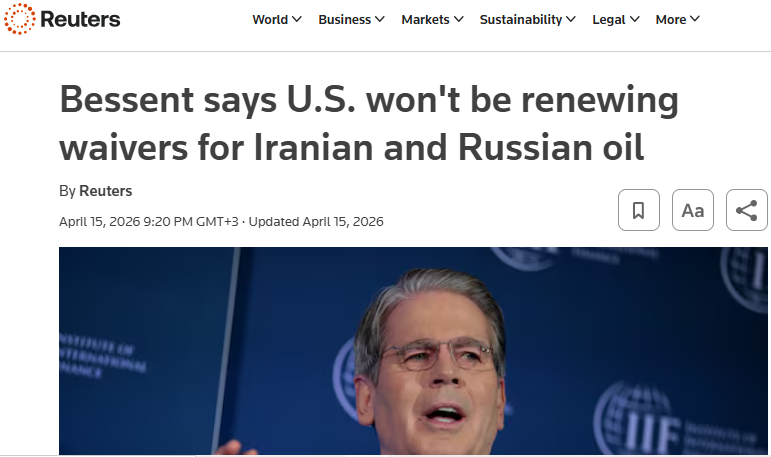
Bessent said more than Reuters reported.
The US is escalating its secondary sanctions against buyers of sanctioned oil – Bessent said Iranian oil but he included Russian oil as well. “We have told companies — we have told countries that if you are buying Iranian oil, that if Iranian money is sitting in your banks, we are now willing to apply secondary sanctions, which is a very stern measure. And the Iranians should know that this is going to be the financial equivalent of what we saw in the kinetic activities.”
“Question: Is this an example of expanding the war economically as opposed to militarily? Is this another phase of the — Scott Bessent: Exactly.” /
At the Security Council in Moscow it was already known that the Russian oil sanctions waiver would not be renewed. It was also understood that Dmitriev had failed in his bid with the Americans. Hostility towards Dmitriev is well-known on the part of the Foreign Minister and the military. Shoigu, however, has remained loyal to Putin’s confidence in Dmitriev. The latter is “Putin’s whisperer”, confirms a source in a position to know.
What could Dmitriev be whispering to Putin to explain his failure with Witkoff, Kushner and Bessent? Why should Putin entrust him with the mission of negotiating much larger-value sanctions issues, such as the release of the Central Bank’s $300 billion in reserves?
Although Dmitriev publishes tweets several times a day, he has avoided the US-Israeli war from February 28; the Iranian fight-back; the Iranian closure of the Hormuz Strait; the April 8 ceasefire; and the Islamabad negotiations of April 11-12. Instead, he has tweeted in support of Trump’s criticisms of NATO.
He has not reported on his negotiations in Miami which open-source press reports identify on January 31-February 1; March 11; and April 9.
One of Dmitriev’s repeating themes is that Russia remains the only reliable political-economic partner of the Trump Administration. He has cast no doubt on his trust in US officials like Witkoff, Kushner, and Bessent to act consistently and in good faith.
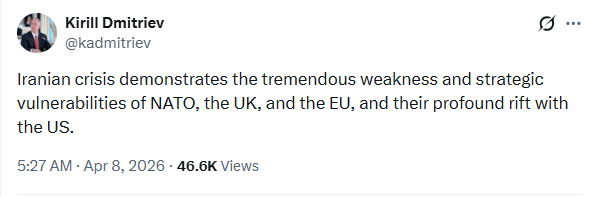
Source: https://x.com/kadmitriev/status/2041704405142270203
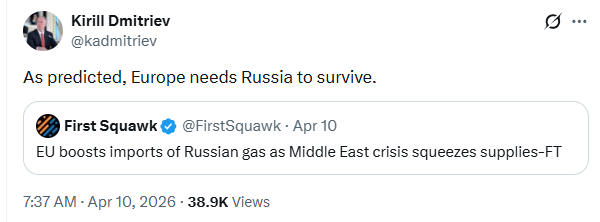
Source: https://x.com/kadmitriev/status/2042462028837921236
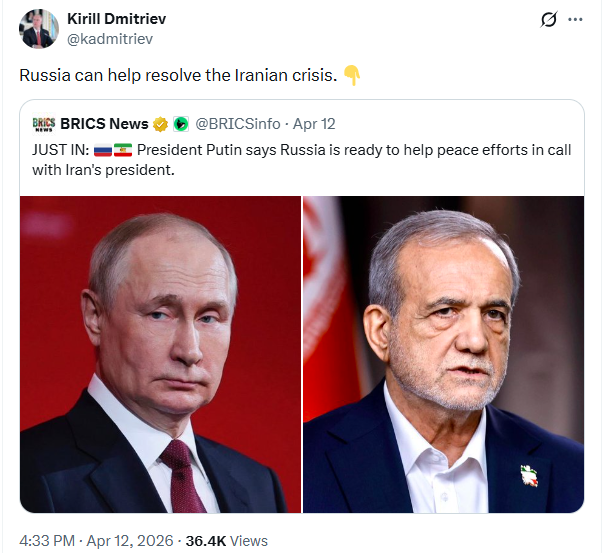
Source: https://x.com/kadmitriev/status/2043321589987496415
Dmitriev has also covered up the failure of his April 9 mission to extend the oil sanction waiver.
When the US Treasury announced the reversal of Bessent’s refusal of April 15 and issued the new General Licence 134B on April 17, Dmitriev was caught by surprise.
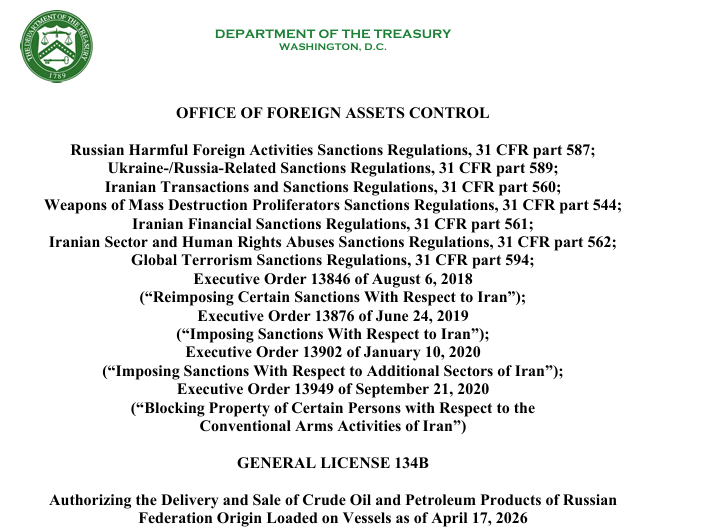
Source: https://ofac.treasury.gov/media/935526/download?inline The new waiver extends from April 17 to May 16. The new waiver does not apply to Iran, North Korea, or Cuba. “This general license does not authorize: (1) Any transaction involving a person located in or organized under the laws of the Islamic Republic of Iran, the Democratic People’s Republic of Korea, the Republic of Cuba, the Covered Regions of Ukraine, as defined by E.O. 14065, the Crimea Region of Ukraine, as defined by E.O. 13685, or any entity that is owned or controlled by or in a joint venture with such persons.”
Reuters, the New York Times, The Hill, and other specialist Washington media, noted that Bessent had been overruled and that the Trump Administration had reversed policy; none reported a source explaining what had happened and why.
Without noting the continuing sanction against Iranian oil, Dmitriev is now celebrating the temporary Russian advantage. However, he has not been able to claim personal credit for negotiating it.
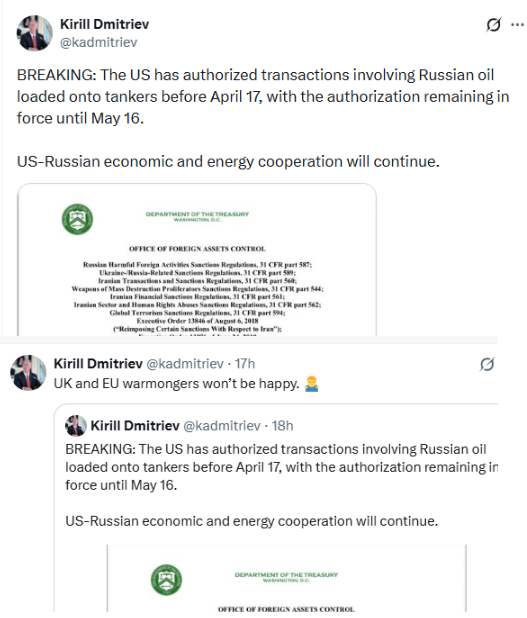
Source: https://x.com/kadmitriev/status/2045316614321537535
This is the policy context and sequence of events which explains the Security Council’s statement of the obvious on April 14. The intended warning is for Dmitriev and for the Kremlin confidence he represents in the outcome of negotiations with the Trump Administration on any and every point. American deceit, Russian failure are no deterrent to Dmitriev, not yet.

Leave a Reply